
Knowing Me, Knowing You
A heartfelt welcome to all of my new subscribers!

A friendly reminder that if anyone is interested in sharing their thoughts about the state of our country anonymously on the Critical Communicator, please reach out via hello@sareneleedswrites.com, or on Signal at sareneleedswrites.15.
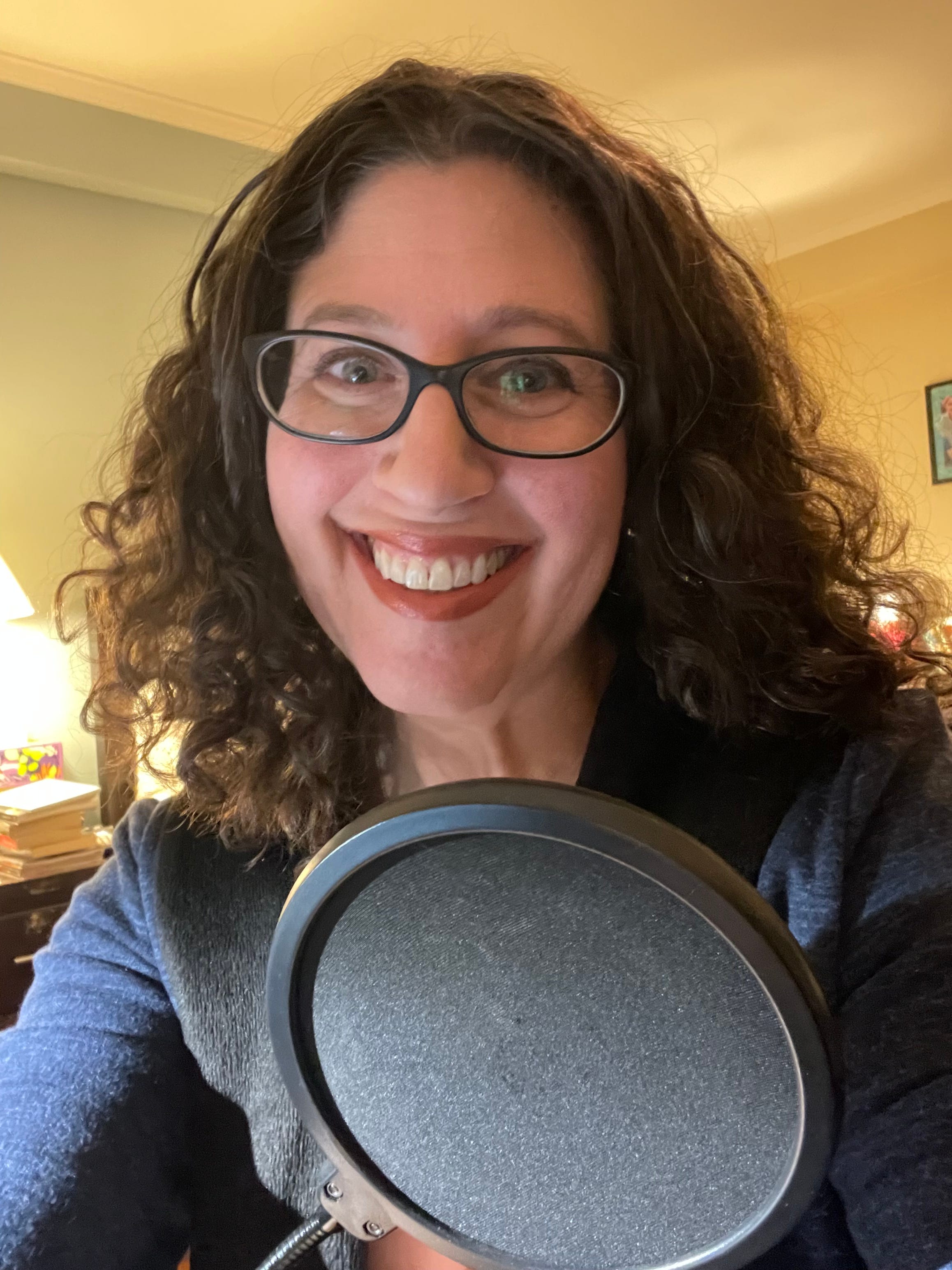
Hello and welcome to my new subscribers!
Today's post is a little different since it's probably a good idea I reintroduce myself and this Substack, the Critical Communicator.
Brief explainer: Last Friday, I posted this Note on Substack as a reaction to the disastrous White House meeting between Ukrainian president Volodymyr Zelenskyy, Donald Trump, and JD Vance:
The next thing I knew, the Note had gone viral: As of this writing, it's up to more than 28,000 likes and over 2,000 restacks. In the past week, my less-than-100 subscriber count has shot up to nearly 400 subscribers!
I'm thrilled to welcome you all here, and I hope you'll stick around!
Here is a quick bio:
My name is Sarene Leeds. I’m a seasoned journalist-turned-professional-writer-and-podcaster. TL;DR resume: Rolling Stone, The Wall Street Journal, Vulture, SheKnows, Rescripted, and the recently concluded podcast “Emotional Abuse Is Real.” A few years ago, I decided to attend graduate school at the ripe old age of 44, and I now also hold a master’s degree in professional writing from NYU. I’m a proud baby Gen-Xer who is passionate about using my voice through the written word, whether it’s advocating for more effective communication in professional settings, writing articles about women’s health, parenting, mental health, TV, and pop culture, or adding my two cents about U.S. politics.
I launched the Critical Communicator two months ago, so it shouldn’t take you too long to catch up on my previous posts (there are only 11 posts in total, including this one and two guest posts). I publish one new post every Friday and also feature anonymous guest writers. If you need an outlet for your frustration over the chaos inflicted by the Trump administration and you're not at liberty to speak publicly, please reach out to me either via email at hello@sareneleedswrites.com or via Signal at sareneleedswrites.15.
All content is currently free, but professional writers like me always appreciate a paid subscription ($5 a month)!
While I usually stick to effective communication, pop culture, and politics on this Substack, I also write about women's health. I invite you to check out my work at Rescripted.com, where I’m a contributing writer.
In full transparency, I didn't intend for this Substack to focus on politics so much, but given what's transpired in the United States since January 20, it's unavoidable. To be clear, I am NOT a political expert, nor am I a political journalist. I'm the last person anyone should look to for hard news reporting or analysis. If you’re looking for political journalism, I’ve highlighted several excellent independent journalists in a previous post, and I suggest checking out my Substack recommendations.
What I do write about is how these political upheavals affect us as human beings: our communication, our interpersonal treatment, our collective mental health, and how, for the sake of our sanity, we need to immerse ourselves in pop culture regularly.
For this week, I’m giving you a taste of what I write about as an ice-breaker of sorts. (This is also because I wanted to touch on two different topics, but neither warranted an entire post, so here we are.) Enjoy!
Saturday Night Live’s decision to have Mike Myers play Elon Musk was a genius move
As someone who spent the 1990s in high school and college, I was the primary audience for Mike Myers’ quirky characters: Whether it was the basement-dwelling slacker Wayne Campbell, the weirdly charming lothario spy Austin Powers, or the combative Scottish patriot Stuart MacKenzie, I fell hook, line, and sinker for Myers’ brand of Anglo-Canadian-inspired, Saturday Night Live-honed comedy.
So, when Myers returned to his old SNL stomping grounds last Saturday, appearing in the March 1 cold open, I was delighted. As expected, the cast re-enacted the catastrophic White House meeting between Trump, Vance, and Zelenskyy. Myers then crashed the scene as a chainsaw-wielding, ketamine-fueled Elon Musk (who was not at the original meeting).
Given that Myers had maybe 24 hours to prepare, I was impressed with his Musk impression. Sure, if you listen carefully, he substituted a mix of his Austin Powers and Ronnie Wood accents for Elon’s South African speech patterns, but who cares?
But the true genius of Myers’ casting might have gone over the heads of younger generations, especially those who have never watched the Austin Powers movies of the late Nineties/early aughts. In addition to the titular international man of mystery, Myers created and starred as Powers’ chief adversary, Dr. Evil.
An egotistical maniac hellbent on taking over the world.
Sound familiar?
I’m not ready to welcome regretful Trump voters into the fold yet
A recurring response to my viral Note about President Zelenskyy and the Ukrainian people was that I should’ve included Republicans who regret their vote, third-party voters, and people who didn’t vote at all.
While I understand that, yes, in the long run, we will have to come together to resist the Trump-Musk regime, I’m not there yet.
I have zero sympathy for the people who voted for Trump, as well as those who either voted third-party or stayed home. That’s because they’re a big reason why we're here in the first place. They didn't listen. They didn't want to believe things would get this bad. They just wanted cheaper eggs.
You break it, you bought it.
You don’t get to latch onto our rage and sorrow because you only now realize what a dumb mistake you made. Like, say, Ryleigh Cooper, a young white woman who voted for Donald Trump because she thought his administration would help with her infertility struggles (not sure where she got that idea). Speaking with CNN’s Laura Coates, Cooper admits she knew her vote would hurt other people. What she never expected was that she would be fired from her federal job.
Cooper now regrets her vote.
Watch their interview here (and make sure to take a peek at the comments):
It really is true: People don’t care about serious problems unless they're directly affected by them. I know this is an overused example, but Martin Niemöller had it right all along:
First they came for the socialists, and I did not speak out—because I was not a socialist.
Then they came for the trade unionists, and I did not speak out—because I was not a trade unionist.
Then they came for the Jews, and I did not speak out—because I was not a Jew.
Then they came for me—and there was no one left to speak for me.
Here’s a more modern example of this idea, and I feel this deep in my bones as I watch so many of my (non-vulnerable, non-federal worker) friends and acquaintances stay silent:
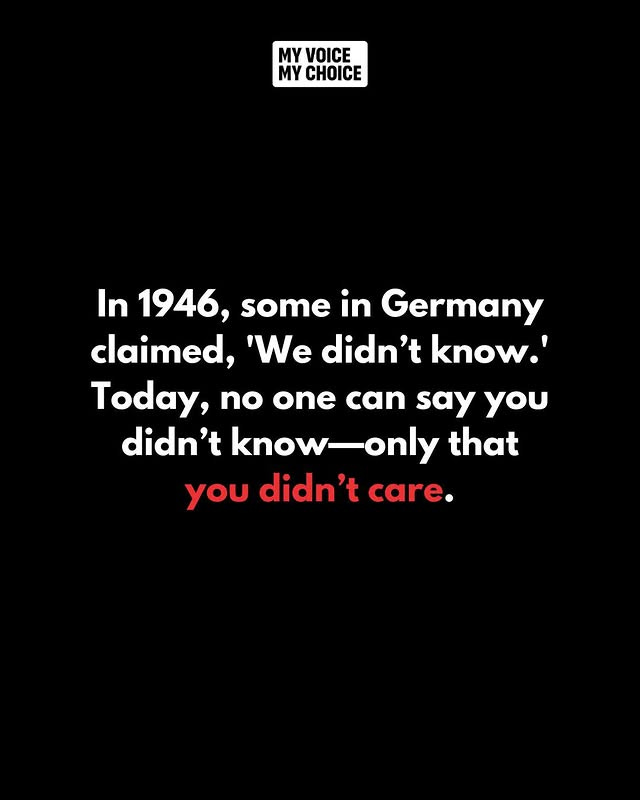
Like many of my fellow Jewish people, I am suspicious of several of my friends/acquaintances these days. Would they help me and my family if this were 1930s Europe? (Btw, if you're reading this and you've noticed I've pulled away from you, then no, I don’t think you would help us. Congrats.)
It's true, we're not going to defeat Donald Trump and his cronies until we get more remorseful Republicans and non-voters on our side. But at the same time, they have to do more than express their regret. They have to start calling their elected officials, they have to start speaking out, and they have to help people in their community to understand how they were duped.
That’s it for this week. Thank you so much for reading and subscribing, and please leave me a comment so I can learn more about you! What brought you over to my Substack, and what are you interested in reading?
I'm looking forward to connecting with you!
P.S. I’m also on Instagram @sareneleedswrites — come find me there too!
The Critical Communicator is a reader-supported publication. To receive new posts and support my work, consider becoming a free or paid subscriber.